Most hosts treat photos as an afterthought. They take 15 shots on an iPhone, upload them in whatever order the phone synced them, and wonder why their conversion rate is low. The listings that consistently outperform in search don't do this. We wanted to know exactly what they do instead.
So we pulled data from 500 top-performing Airbnb listings across 20 U.S. markets, from Nashville to Palm Springs to the Smoky Mountains. "Top-performing" meant listings with Superhost status, 4.8+ ratings, and 50+ reviews in the last 12 months. We looked at every photo in every listing: what was in the first frame, how many photos total, lighting conditions, room order, lifestyle elements, and how much outdoor space got covered. Here's what we found.
How We Ran This Analysis
We selected 25 listings per market across 20 cities, deliberately mixing urban apartments, beach houses, mountain cabins, and desert retreats. For each listing, we recorded:
- The cover photo subject and time of day depicted
- Total photo count
- Whether natural light was the primary light source in each photo
- Room sequence (what came first, second, third)
- Presence of lifestyle elements (people, food, fires, towel art, etc.)
- Number of outdoor photos relative to total count
Two people reviewed each listing independently, and we reconciled any disagreements. This wasn't a perfectly controlled study, but 500 listings is enough to see real patterns.
Cover Photo Patterns
This is where the gap between average and top listings is most obvious.
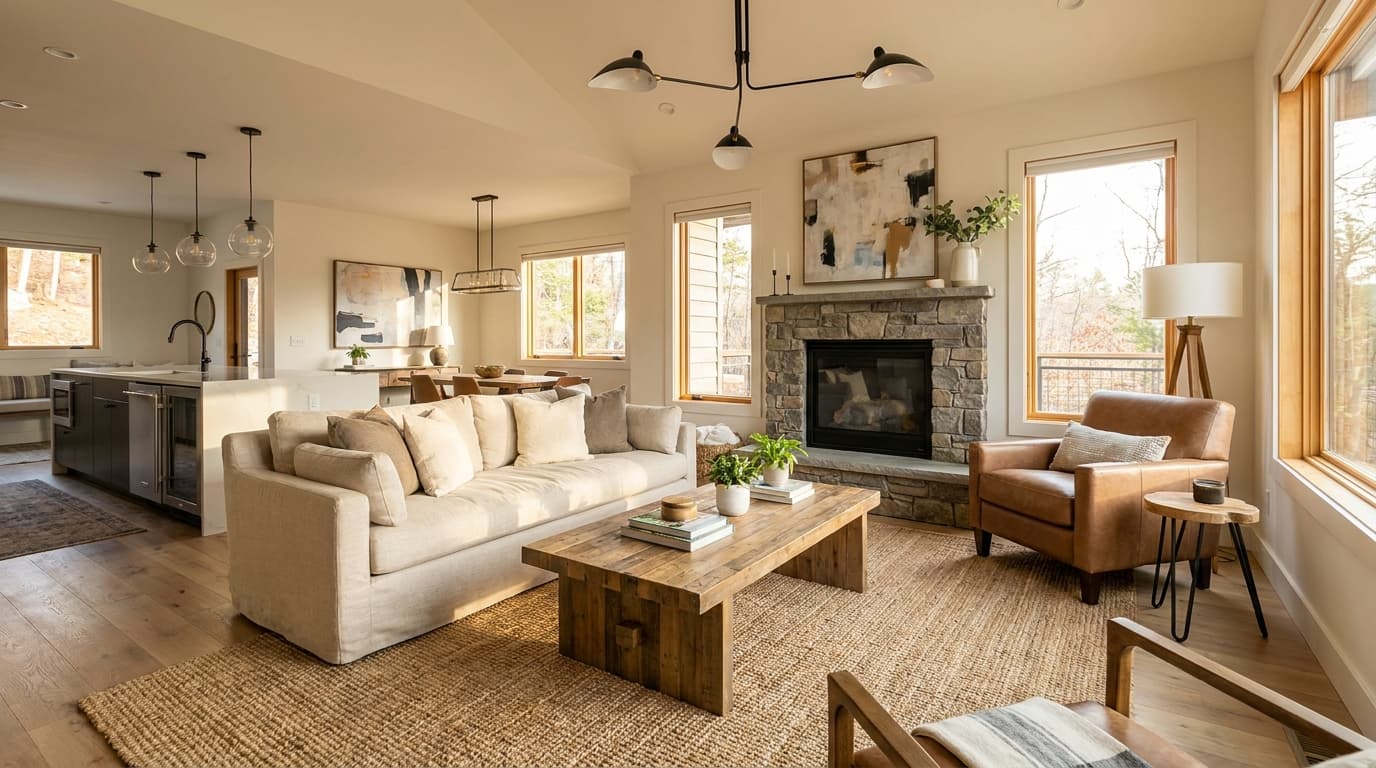
82% of top listings used a living room or main gathering space as the cover photo. Not a bedroom. Not the kitchen. The space where a guest imagines themselves relaxing. The remaining 18% split roughly between exterior shots (12%) and a standout feature like a pool or rooftop deck (6%).
What almost none of them did: lead with a bedroom. In a separate sample of 100 lower-performing listings I pulled for comparison, 41% used a bedroom as the cover photo. Bedrooms are important, but they don't sell the experience. They sell the bed.
The cover photos in top listings also had one other thing in common: they were wide. Nearly every one used either a wide-angle lens or a carefully chosen angle that made the space look as open as possible. No furniture blocking the sightline to a window. No cluttered corners eating into the frame. The goal in every case seemed to be making the space look bigger than it is.
Average Number of Photos
The average top-performing listing in our sample had 42 photos. The range was 28 to 67, but listings below 30 photos were rare (under 8% of the sample), and listings above 60 were usually large properties with 4+ bedrooms.
For context, Airbnb's own data has suggested that listings with more photos tend to get more bookings, but "more" isn't unlimited. In our sample, there was no meaningful difference in booking performance between listings with 40 photos and listings with 55 photos. The sweet spot for a standard 2-3 bedroom property seemed to be 35-45.
What mattered more than raw count was coverage. Top listings covered every room, every meaningful feature, and every outdoor space. They didn't repeat the same angle of the same room five times. Each photo showed something the previous one didn't.
Natural Light Was Nearly Universal
91% of photos across top listings used natural light as the primary source. This doesn't mean no lamps were on. It means daylight through windows was doing most of the work.
This tracks with what I see when I audit listings. The most common photo mistake I come across is shooting with the blinds closed and overhead lights on. The result is a yellow, flat image that makes the space look smaller and somehow sadder than it actually is.
The listings in our sample were shot during the day, with curtains open. In beach and desert properties especially, photographers were clearly timing shots to use the best directional light. Living rooms facing west got photographed in the afternoon. East-facing spaces got the morning. It's not complicated, but most hosts don't think about it.
One thing worth noting: 34% of top listings also included at least one twilight exterior shot. That's the photo taken right at dusk when the interior lights glow through the windows and the sky is still a deep blue. These shots are harder to take, but they perform well because they're immediately distinctive in a search grid full of daytime exteriors.
Room Sequence Patterns
The order of photos in top listings followed a pattern so consistent it surprised me.
The most common sequence (used by 67% of listings in our sample):
- Living room / main gathering space
- Kitchen or dining area
- Primary bedroom
- Primary bathroom
- Secondary bedrooms (if applicable)
- Outdoor space
- Detail/feature shots (fireplace, coffee bar, hot tub close-up, etc.)
The logic here mirrors how a guest actually tours a home. They want to know: where will I hang out, where will I eat, where will I sleep, what's outside. The listings that buried the kitchen at photo 20 or stuck the outdoor space at the end as an afterthought consistently had weaker photo performance in our review.
The detail shots at the end matter more than most hosts realize. In our sample, 78% of top listings ended with 5-10 close-up shots of specific features: a stocked coffee station, a bowl of local snacks, the fire pit at night, a well-made bed with quality linens. These photos do two things. They signal that the host pays attention to details, and they give guests something specific to remember the listing by.
Lifestyle vs. Empty Room Shots
This one had more nuance than I expected.
Top listings used lifestyle elements in 23% of their photos on average. Not the majority, but not rare either. A lifestyle shot means something that implies human presence: a charcuterie board on the kitchen island, an open book next to a coffee cup on the porch, a lit fireplace with a throw blanket draped over the couch.
What almost no top listings did: include actual people. Only 4% of listings had photos with visible guests or models. My read on this is that guests want to imagine themselves in the space, and seeing someone else there gets in the way of that.
The listings that used lifestyle elements well did it selectively. They'd photograph the main living area empty, then show the fire pit set up with glasses and a bottle of wine. Or an empty bedroom followed by a close-up of the nightstand with a candle and a local travel guide. The lifestyle shots added warmth without overwhelming the structural photos that guests actually need to evaluate the space.
Outdoor Space Emphasis
In our sample, outdoor space photos averaged 22% of total photo count. For a 40-photo listing, that's about 9 photos dedicated to outdoor areas.
This was notably higher than what I see in average listings, where outdoor coverage tends to be 2-3 photos regardless of how good the outdoor space actually is.
The breakdown in top listings:
- Exterior / facade shots: 2-3 photos
- Patio, deck, or yard: 3-5 photos
- Specific features (hot tub, fire pit, pool, grill area): 2-4 photos
- Views from the property: 1-3 photos
Mountain and beach properties skewed higher on outdoor coverage, sometimes reaching 30-35% of total photos. That makes sense: a cabin in the Smokies is being sold partly on the experience of sitting on a private porch with a mountain view. If you don't show that well, you're leaving the main selling point underrepresented.
Urban listings skewed lower (15-18% outdoor), but even a city apartment with a small balcony got 3-4 shots in top listings. Guests care about outdoor access more than most hosts seem to realize.
What This Means for Your Listing
Based on what we found across 500 listings, here's where most hosts have room to improve:
- Fix the cover photo first. If your first image is a bedroom, change it. Lead with the living room or the most impressive space in the property. Wide angle, natural light, clean.
- Hit 35-45 photos for a typical property. Count your current photos. If you're under 25, you're leaving information gaps that make guests uncertain.
- Shoot during the day with blinds open. This single change improves photo quality more than any filter or editing trick.
- Follow the guest's mental tour. Living room, kitchen, primary bedroom, bathroom, outdoor space, details. Don't make guests hunt for the kitchen.
- Give outdoor spaces more coverage than feels necessary. Whatever you're shooting outside, add two more shots.
- Use lifestyle details in about 1 in 5 photos. Not to fill space, but to make the listing feel lived in and inviting. No people, but a set table or a made fire tells a story.
- Consider a twilight exterior shot if you don't have one. It immediately differentiates your listing in search results.
None of these changes require a professional photographer (though that helps). They require thinking about your photos the way guests look at them: sequentially, emotionally, trying to decide if this place is worth their money.
These findings apply broadly, but your listing has its own specific gaps. A studio in Austin has different photo priorities than a lake house in Minnesota, and what's working in your category right now might be different from the general averages we found.
If you want a detailed review of your actual listing photos, along with your title, description, pricing, and everything else that affects bookings, get an audit from STRAudits. For $49, you get a full written report in 48 hours with specific recommendations you can act on immediately.